Press Release · Sina Finance
From Global Dialogue to Everyday Action: Highlights from the 2026 Sustainability Global Leaders Conference
Distributed by Times Beats · Originally issued via PR Newswire
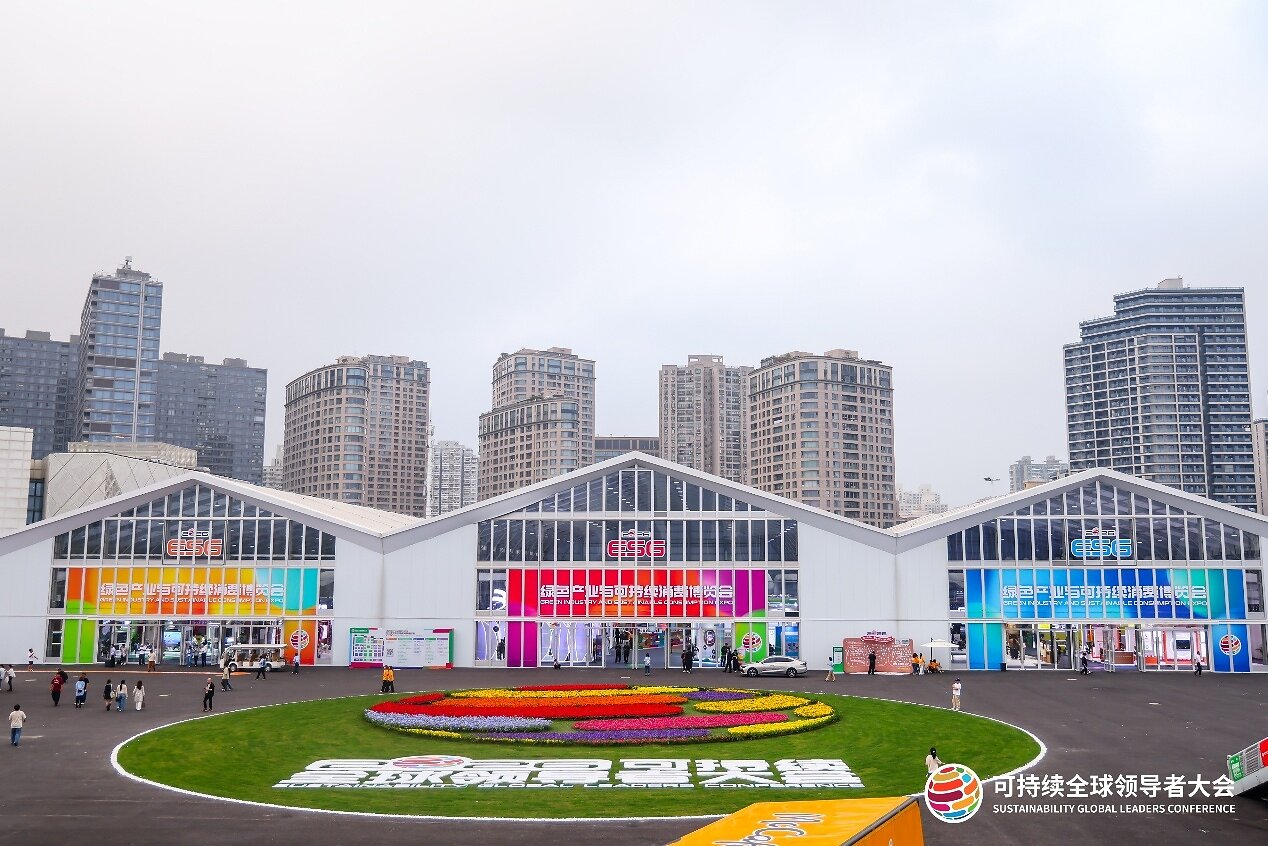
SHANGHAI, Nov. 4, 2026 — The 2026 Sustainability Global Leaders Conference brought together policymakers, academics, business leaders and international organizations in Shanghai from October 20 to 22, conveying a vital message: building a more resilient future requires actions beyond the conference venue. Notably, the conference itself was carbon-neutral, putting its sustainability commitments into practice.

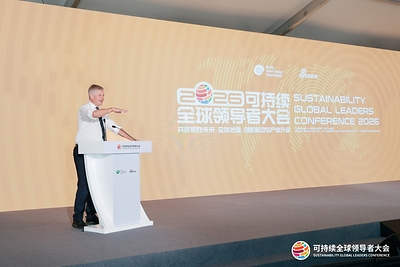
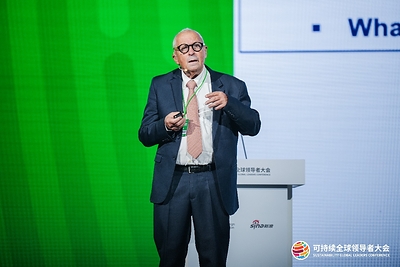

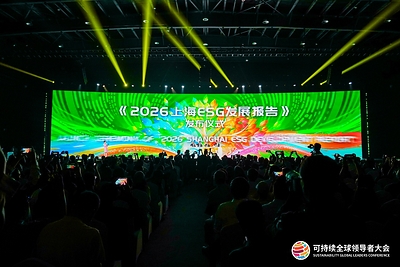
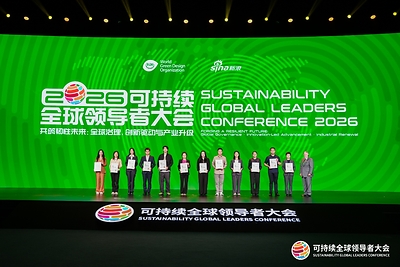
Held at Litan Cultural Center in Huangpu District, Shanghai, the conference was co-hosted by the World Green Design Organization (WGDO) and SINA Group, with the Beijing Office of the IFRS Foundation as a supporting organizer. Under the theme "Forging a Resilient Future: Global Governance, Innovation-Led Advancement & Industrial Renewal," the three-day event recorded more than 13,000 in-person visits and featured more than 400 speakers from 28 countries. International participants accounted for more than 40% of speakers, including 33 heads of international organizations and 72 senior executives from financial institutions in China and overseas.
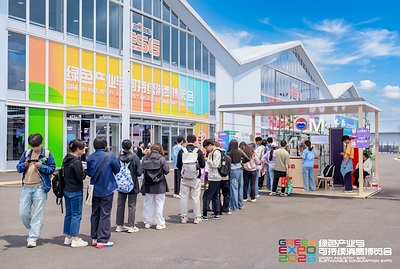
The program comprised 15 parallel forums and 50 discussion topics across three days, alongside the second Green Industry and Sustainable Consumption Expo. But the conference was not just about debating sustainability. Exhibitions, cultural activities, public events and corporate visits offered practical examples of how sustainability can be incorporated into business and everyday life.
China's Green Transition and the Global Debate on AI
China's role in the global energy transition drew recognition from international speakers. Irina Bokova, former director-general of UNESCO, described China as an important supporter and defender of multilateralism. She highlighted China's achievements in scaling up manufacturing and clean energy technologies, saying China's industrial capabilities were helping make the global energy transition possible.
Erik Solheim, chair of the Europe Asia Center, former under secretary-general of the UN and executive director of the UNEP, made a similar point, noting that China's development of new energy technologies had helped bring down the cost of green technologies and made the transition more accessible globally.
Artificial intelligence was another major focus, with speakers emphasizing the need to balance technological progress with public accountability.
Joseph Sifakis, 2007 Turing Award Laureate, called for international standards for AI regulation. Tawakkol Karman, 2011 Nobel Peace Prize laureate, stressed that the debate must go beyond what AI can do to consider who controls it, who benefits and who bears the risks. AI can transform healthcare, education, industry and energy, Karman argued, but technology must remain in the service of humanity rather than the other way around.
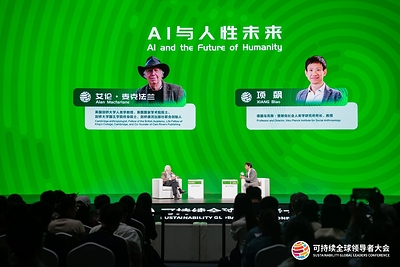
These questions took center stage in a high-level dialogue titled "AI and the Future of Humanity," which examined the technology's implications for social relationships, human agency and the distribution of economic gains.
Alan Macfarlane, Cambridge anthropologist and Fellow of the British Academy, proposed establishing a "trust fund" to channel some of the profits generated by AI toward public welfare, rather than allowing technology companies to capture the gains exclusively. He also warned that AI platforms could exploit users' anxieties, or even deliberately heighten them to sell products.
Xiang Biao, Professor and Director, Max Planck Institute for Social Anthropology, focused on what he sees as the erosion of people's connections with their immediate surroundings — the people, places and communities that make up everyday life. In the AI era, he argued, people risk both withdrawing from the wider world and retreating into themselves.
His concept of "taking oneself as a method" offers a way to counter this tendency: starting from personal experience to rebuild meaningful connections with the world, rather than turning inward and shutting it out.
The discussion also addressed a familiar concern among younger people: how to find a sense of passion and direction. Macfarlane suggested beginning with small experiments, making a list of interests and trying them out one by one. Interests can develop into passions through engagement with other people, he said.
Together, the two scholars brought the discussion back to a fundamental question: as AI reshapes society, how can people preserve their agency and maintain meaningful connections with the world around them?
Alongside the formal discussions, a series of activities connected sustainability with cultural heritage, recycling, public health and corporate practice.
Yuyuan Garden puts cultural heritage in the spotlight
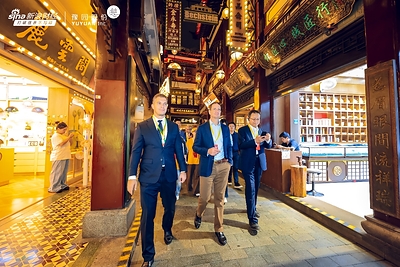
On the opening day, the conference organizers hosted the "Huangpu Grand Yuyuan Garden Night," bringing international guests to Yuyuan Garden Mall for a program centered on intangible cultural heritage.
The program combined visits to commercial and cultural spaces, an immersive evening tour of Yuyuan Garden, a themed dinner and hands-on demonstrations of traditional crafts. It showcased Huangpu's cultural heritage while highlighting efforts to keep traditional practices relevant to contemporary life.
Recycled milk cartons become a statement piece
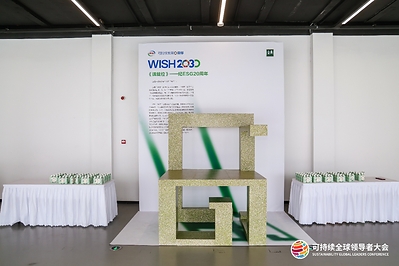
One of the most visible installations at the venue was Please Take Your Seat, a series of chairs designed and made from approximately 6,300 recycled milk cartons.
The installation offered a straightforward message: everyone has a role to play in sustainable development. Small individual actions, when combined, can help build the foundation for a broader green transition.
Photography captures the everyday side of sustainability
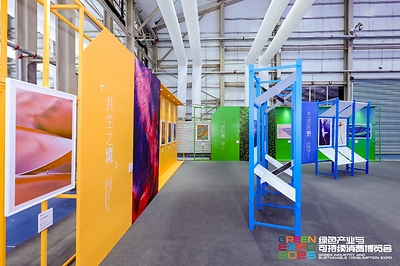
During the second Green Industry and Sustainable Consumption Expo, Sina presented a photography exhibition titled "A Moment Worth Sustaining." The exhibition featured scenes of people living alongside nature, discarded objects finding new uses and small efforts to reduce waste.
Rather than focusing solely on large-scale environmental challenges, it drew attention to the everyday choices through which sustainability takes shape.
A riverside run and green market bring sustainable living to the public
The conference organized a 3.3-kilometer morning run along the Huangpu River, starting at the Huangpu Riverside Greenway and ending at the conference venue. The event promoted the message "WE WISH: Sharing Health with the World," linking physical well-being with public participation.
The Green Lifestyle Festival offered another way for visitors to engage. It brought together dozens of sustainable lifestyles, cultural and creative brands, along with nearly 15 specialty food brands. Through shopping, food and interactive activities, visitors could explore circular reuse, waste reduction and energy conservation in a more accessible setting.
New Reports and Awards Highlight Practical Progress
The conference also marked the release of Advancing Sustainable Development: Shanghai ESG Development Report 2026, the third annual edition of the report. Led by the Shanghai Advanced Institute of Finance at Shanghai Jiao Tong University (SAIF) in collaboration with financial institutions, companies and service providers, it examines how different stakeholders can strengthen their environmental, social and governance capabilities.
The report is intended to provide practical reference points for policymakers, corporate executives and financial institutions, drawing on Shanghai's experience in ESG development.
Two further publications and an awards program were announced during the conference.
In collaboration with the Center for Environmental Education and Communications of China's Ministry of Ecology and Environment and SynTao Consulting, Sina co-published the 2026 Compendium of Corporate ESG Practices. The conference organizers, WGDO and Sina, also presented the 2026 Green Design & ESG Pioneering Enterprise Award to recognize companies for their outstanding achievements in sustainability. In addition, Sina and SAIF announced the results of the 2026 Global Youth Sustainability & ESG Investing Challenge and launched the 2027 edition.
Making Sustainability Part of Everyday Life
The conference's activities offered a consistent message: sustainability cannot be advanced through policy and investment alone. It also depends on how businesses operate, how communities engage with environmental challenges and how people make everyday choices.
A chair made from recycled packaging, a morning run along the Huangpu River, and an exhibition documenting the reuse of discarded objects all illustrated different ways of putting sustainability into practice.
No single technology or agreement will deliver a sustainable future on its own. Progress depends on the cumulative effect of individual efforts, supported by effective policies, responsible business practices and international cooperation.
The challenge is to make sustainability more than a commitment on paper — to embed it in the decisions businesses make, the products people buy and the ways communities live. That is how a more resilient future can be built, one practical step at a time.
SOURCE Sina Finance